
- VIAC
-
ARBITRATION
- Arbitrate at VIAC
- VIAC eCase
- Combination of Arbitration and Mediation
- International Arbitration
- Resources
- NEWS & EVENTS
- Contact
-




On the evening of August 13, 2026, as part of the Ho Chi Minh City Legal Management Series 2026 (LMS 2026), the talkshow on “Arbitral jurisdiction in resolving disputes arising from digital financial transactions” was co-organized by the Vietnam International Arbitration Centre (VIAC) in collaboration with the Ho Chi Minh City Investment and Trade Promotion Centre (ITPC), attracting the attendance of nearly 100 enterprises.
The talkshow was moderated by Ms. Nguyen Thi Hai Chi - Partner at CDR Counsels LLC, VIAC’s Arbitrator, featuring the participation of panelists: Dr. Ha Cong Anh Bao - Vice Principal in charge of the School of Law and Political Science, Foreign Trade University, VIAC’s Arbitrator; and Ms. Nguyen Thi Diep – Partner at LNT & Partners. The talkshow centered on discussing the applicability of arbitration to disputes arising from digital financial transactions, concurrently addressing relevant legal issues to ensure the effectiveness of dispute resolution within the context of digitalization and international integration.
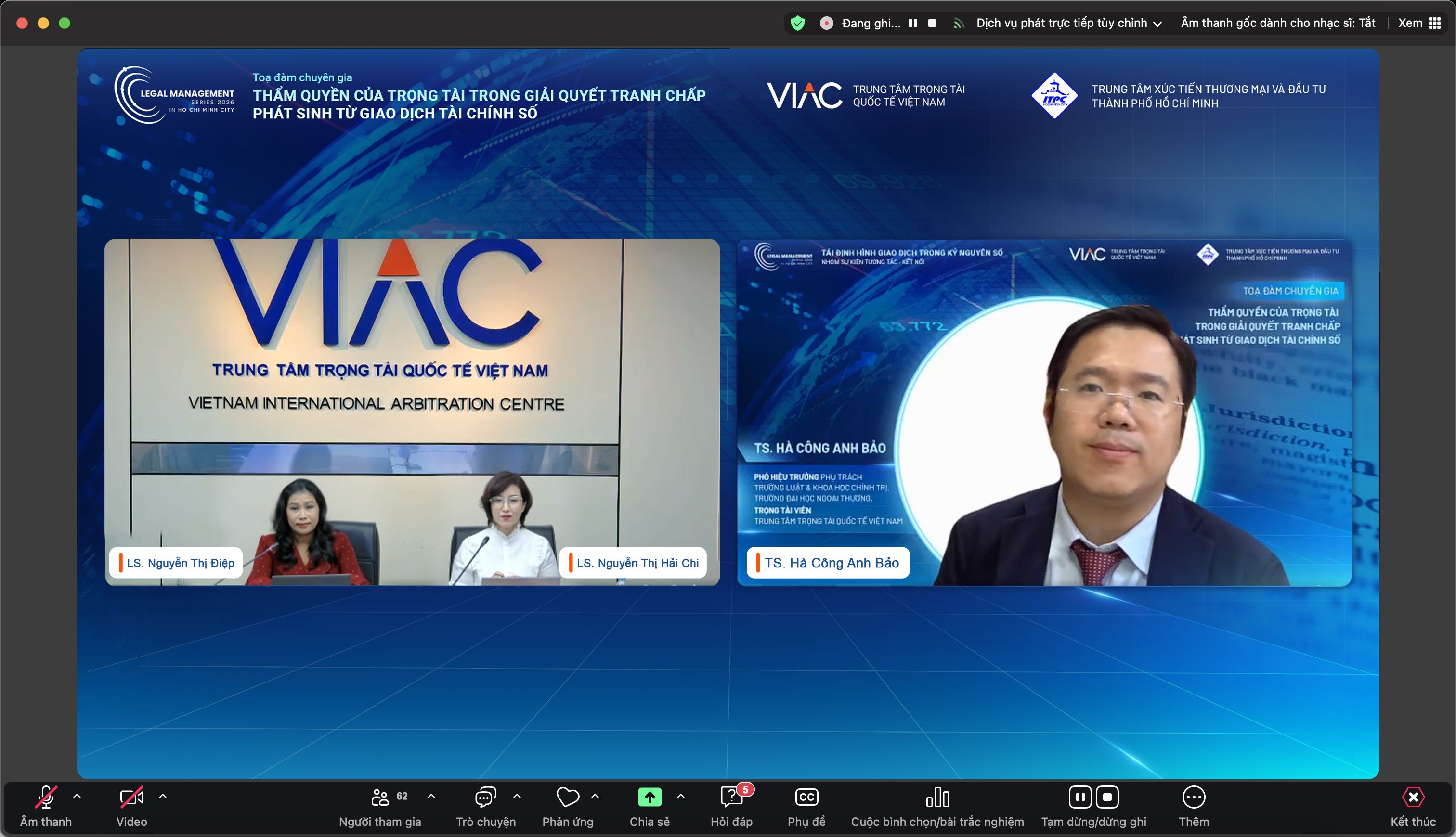
In light of the characteristics of digital platform transactions, the speakers also analyzed critical aspects concerning the validity of arbitration agreements within the digital environment, particularly emphasizing the way the terms/clauses are displayed and presented on the platforms. According to the speakers, the mechanisms for displaying and confirming the clauses are of paramount importance in evidencing the user's consent to the substance of the agreement between the parties. Furthermore, given the anonymous nature of digital platforms, enterprises must comprehensively archive verified data and system logs to evidence the agreement formation process should disputes arise. This is because the user's “trail of intent” will serve as a verifiable chain of evidence, as opposed to relying on mere isolated documents.
Regarding the cross-border aspects of digital financial transactions, a distinction must be drawn between the seat of arbitration and the location of servers, the platform's technical infrastructure, the locus where the transaction is recorded on the blockchain, or one party residence. If a transaction is executed in Vietnam while the servers are located in a foreign jurisdiction, yet the agreement designates the server's location as the seat of arbitration, the parties will incur significant time and cost burdens should a dispute arise. Furthermore, the seat of arbitration determines the domestic or foreign status of the arbitral award, thereby dictating the legal support system for litigation and the enforcement of the award. Accordingly, the speakers cautioned that parties should expressly designate the seat of arbitration at the contract drafting phase to avoid a scenario where they prevail in the dispute but fail to recover the disputed value due to procedural problems.
Following the expert discussions, under the moderation of Ms. Nguyen Thi Hai Chi, the talkshow proceeded with the open discussion and information exchange session between the experts and the attending delegates. These discussions contributed to further elucidating the applicability of arbitration to disputes arising from digital financial transactions, concurrently underscoring the necessity of accurately delineating the scope of arbitrable disputes and proactively designing an appropriate dispute resolution mechanism upon the formation of the transaction.
▶️ Watch the program again here: https://www.youtube.com/watch?v=JPxz500dhNY


![[Recap LMS 2026] Business Legal Lens (BLL) #02: “Force majeure: The gap between business understanding and legal approach”](/images/News-and-Events/2026/News/LMS 2026/BLL02/IMG_0136.jpg)
![[Recap LMS 2026] VIAC & ITPC co-organized the Business Legal Lens (BLL) #01: “Conditions precedent in loan agreements: Understanding correctly to prevent risks”](/images/News-and-Events/2026/News/LMS 2026/BLL 01/IMG_8873.jpg)
![[Recap LMS 2026] Talkshow “Exemption from liability for technology-related risks in logistics transactions”](/images/News-and-Events/2026/News/LMS 2026/Logistics/LMS2026_2708---Slideshow-1.jpg)
![[Recap LMS 2026] Talkshow “Commercial contracts with counterpart clauses – Streamlining contract formation or increasing legal risks?"”](/images/News-and-Events/2026/News/LMS 2026/Thuong mai/LMS2026_2008_Speakers.png)



.png "Trường đại học ngoại thương")